
The mindbody connection offers a different way of understanding persistent pain and physical symptoms, particularly when emotional experiences, stress and trauma are also part of the picture. In this Meandering, I explore the relationship between pain, emotional suppression and the body’s protective responses and how becoming more curious about our inner worlds may help us develop a deeper, more compassionate relationship with our bodies making space not only for healing, but for greater joy, vitality, awe and wonder.
🪶
A client recently arrived for her therapy session with terrible shoulder pain. She mentioned it in passing, before quickly moving on to talk about something else. Gently, I asked her to pause and brought her back to her shoulders; one, to simply make space for her experience and as well, to see what her shoulders might be expressing. It was not long before the emotions rose to the surface, and she was then able to give voice to them, whilst attending to the parts of her she had been ignoring. Before the end of our session, I asked how her shoulders were doing. She realised the pain had gone completely.
Because we have - over the centuries - typically come to separate the mind from the body, when pain is spontaneously relieved, it can feel like magic or a miracle cure 💫 But it isn't and as much as I'd love to believe it was, it's actually solid science.
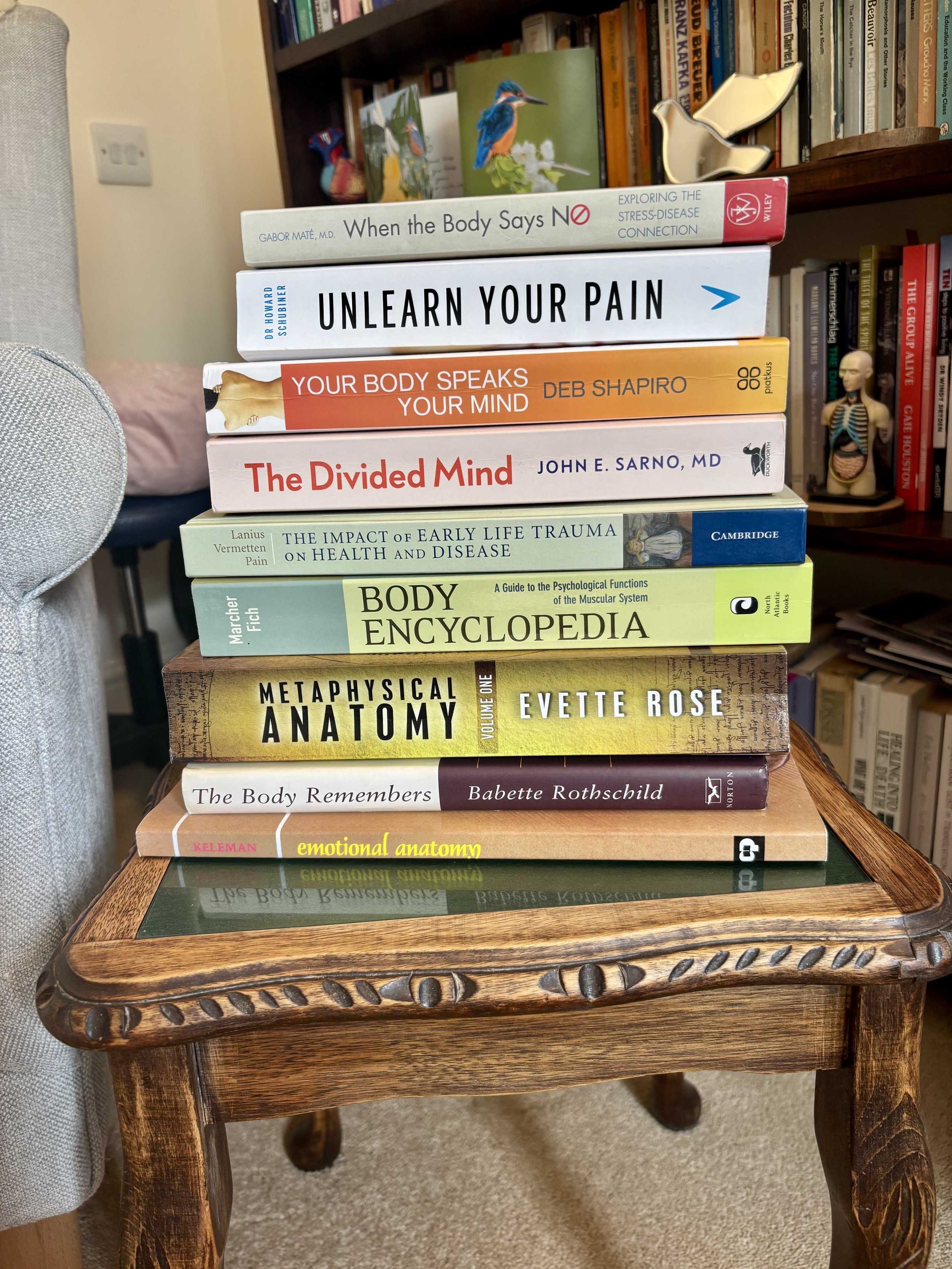
What we now understand about pain is that it is not simply a direct result of physical damage or injury. Pain is produced by the brain / nervous system as a protective response. It draws on information coming from the body as well as from our past experiences, emotional state, thoughts, beliefs, expectations and our perception of threat.
The brain is constantly learning and updating itself. If we repeatedly experience something as threatening, overwhelming or unsafe, our nervous system can become increasingly sensitised to those danger signals, sometimes continuing to produce pain even when there is no longer a physical injury. It can become a self-reinforcing loop: perceived threat → danger signal → pain → increased perception of threat → more danger signals → more pain etc. The pain is absolutely real; it is simply not always a straightforward reflection of physical injury = physical pain.
And this is where emotions come in. As I've said before, emotions are not abstract things that happen somewhere inside our heads. They are biological events, involving chemical changes throughout the brain and body. When we habitually suppress, override or disconnect from difficult emotions, they do not disappear, they continue to influence our physiology and the way we experience ourselves in our bodies.
Oftentimes, bringing our attention back to the body and allowing ourselves to feel what is actually happening - giving the emotion some room to breathe and be felt - can profoundly change our embodied experience. In so doing, we begin to interrupt that self reinforcing loop of perceived threat → danger signal → pain, allowing the nervous system to instead update its interpretation of what is taking place. Rather than continuing to suppress or avoid an emotion that the unconscious brain has learnt to perceive as threatening, we are showing our brain-body through direct experience, that we are now safe enough to feel, process and move through it.

I am by no means saying that every physical symptom has an emotional cause, or that we should overlook physical investigation and appropriate medical care. But it does give us another lens through which to explore what is happening in our bodies - consider it another invitation to deepen into loving relationship with ourselves.
We can then become curious about the timing of our symptoms, what is happening in our lives when they arise or intensify, what emotions are present and the difference we notice in our body when we make space for them instead of pushing those feelings away. Entering into this dialogue - quite spontaneously - can begin to evoke feelings of care and compassion for ourselves; a key factor in our capacity to begin to recover and heal.
But it isn't just the uncomfortable feelings we may tend to ignore or avoid. When we become practised at suppressing what feels difficult, we can also become less available to the full range of our emotional experience. Research into emotional suppression has found associations between suppressing emotion and reduced positive feeling states i.e. inhibiting emotional expression can dampen the experience of positive emotion too. So if we become accustomed to keeping a lid on anger, grief, fear or sadness, we may also become accustomed to keeping a lid on the upswell of excitement, creativity, pleasure, joy and even love. The capacity to feel deeply cannot be so neatly divided into the emotions we want and those we don't. What I see so often in the therapy room, is that by learning to make more room for the full repertoire of our emotional experience, we also allow the joyful, pleasurable parts of our experience to flow more freely too.
When we pause for a moment, turn towards what is happening inside us and allow ourselves to feel and meet ourselves, something will invariably shift. Sometimes the pain softens, or the body relaxes. Or sometimes something entirely new and unknown emerges from the unconscious. And that's the bit that can sometimes feel like a miracle. When we have been so accustomed to ignoring our emotional experience and dulling our senses, beginning to delight in ourselves once again - to feel our vitality and life force - can feel extraordinary, magical and exciting.
And so the invitation, as always, is simply to become a little more aware, a little more curious, a little more compassionate and a little more willing to listen in to our inner worlds. Imagine, then, that in making more space for the fullness of our emotional experience, we might not only change our relationship with pain, but also allow more joy, vitality, awe and wonder to flow into our bodies and our lives.