
Persistent pain, fatigue, anxiety and other physical symptoms can become more prominent during the midlife years, inviting us to reconsider the relationship between our emotional and physical health. In this Meandering, I reflect on the mind-body connection, perimenopause, trauma and embodied psychotherapy, exploring how our bodies may carry stories that long to be acknowledged, understood and heard.
🪶
The energy and heat of Summer seem to have catapulted me into a rabbit hole - all about health. It also seems that the season of midlife is when our health begins to rear its head and make itself a priority…or perhaps more specifically, when we are no longer able to ignore the conversations our bodies have been trying to have with us!
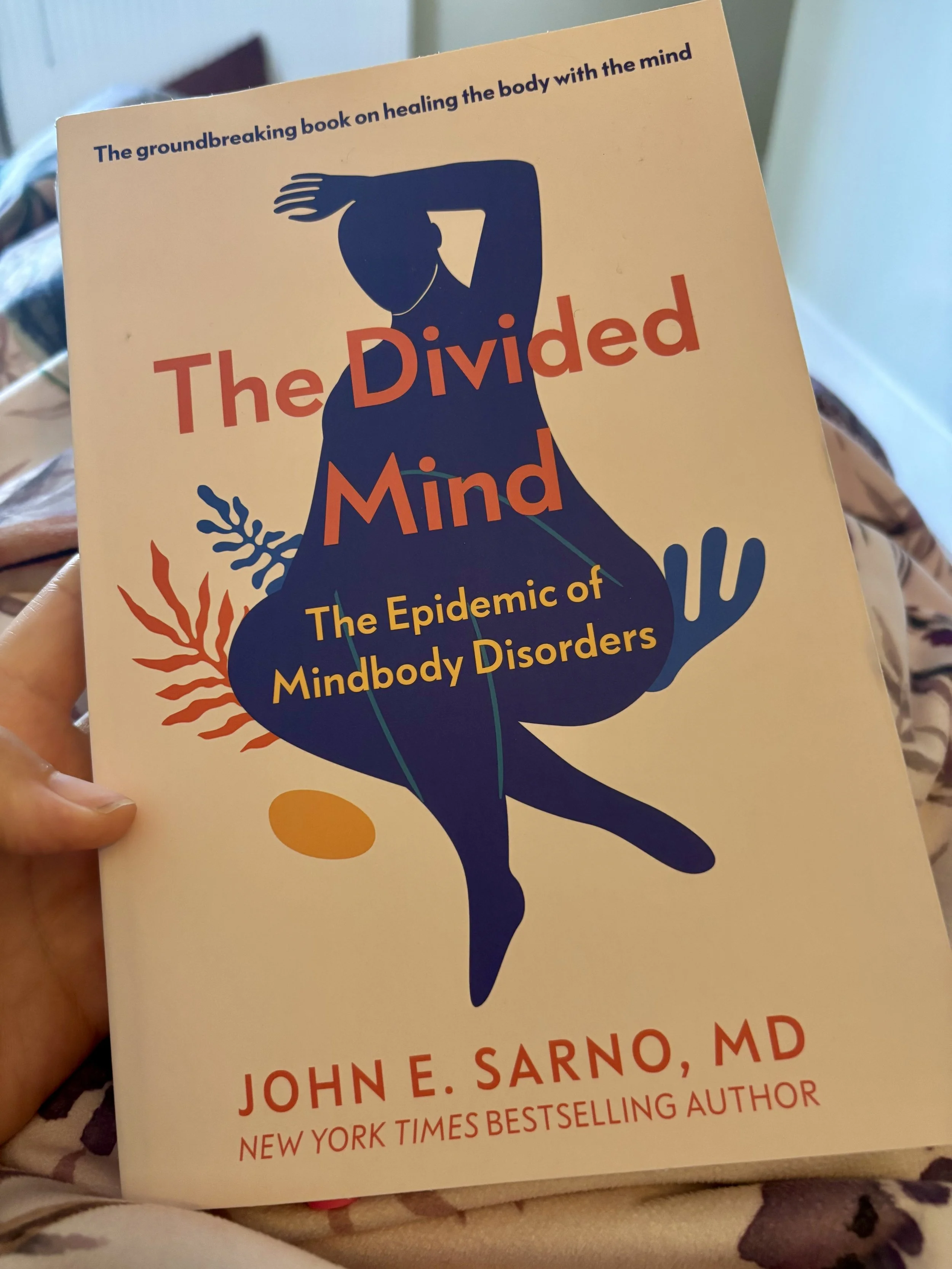
So I have been burrowing away over recent months, researching an area that has been profoundly reshaping how I think about pain, health and the unbelievable intelligence of the human body. I've recently been exploring the work of Dr John Sarno, whose research into what he called the MindBody Syndrome suggested that many persistent physical symptoms are not always the result of structural damage alone, but can also be intimately connected to our emotional inner worlds, that is our feelings, experiences and conflicts that remain unprocessed and continue to live within the body. His work has since been expanded by many clinicians and researchers and while this framework does not explain every illness or every kind of pain, it offers an important invitation, namely, to become curious about the conversations our bodies may be trying to have with us. This invitation feels particularly relevant in midlife, when many women find themselves at a point where the strategies that once enabled them to adapt and cope can no longer be sustained in the same way.
In my work as a psychotherapist, I have spent many years listening to the stories held and expressed through the body. Trauma. Grief. Fear. Shame. Rage. Habitual patterns: The relentless internal pressure to be good, capable, accommodating, to push on and on beyond our limits no matter what. Sometimes clients might be well use to telling these stories, other times, the stories might arise for the very first time in the therapy room. But what I can almost always guarantee, is that most will not have felt the emotions that these stories evoke, even though they know the narrative well.
We often learn in early life that our emotions, particularly the stickier more uncomfortable ones, are too dangerous, too inconvenient or too overwhelming to express. Usually unbeknownst to us, we become remarkably skilled at unconsciously holding them in, until, one day, the body begins to say no. First quietly with small signals here and there and then, when left unheard, it can begin to amplify into a rage induced scream! This is not a punishment, though it can feel that way. But instead, we might look at it as an intelligent attempt by the body to grab our attention and direct us toward that which is in desperate need of our tender loving care and attention. And for many women, we begin to feel this acutely around the threshold of midlife.
Sagessence or perimenopause is often spoken about in terms of fluctuating hormones, and hormones matter hugely. They influence our brain, our nervous system, our mood, our metabolism, our tissue, skin and as we can all attest, profoundly affect the way we feel. And as well, this season demands something more of us. It unapologetically lifts the carpet to reveal all the shit we've spent a lifetime suppressing and sweeps it right back out again!
So it is no surprise then, that many women arrive in my therapy room exhausted (not to mention depleted of vital minerals and nutrients!). They have spent decades caring for children, supporting partners, building careers, tending ageing parents, meeting everyone else's needs while quietly sacrificing themselves and abandoning their own physical and emotional needs.
But for many of us, sometimes as early as our mid thirties onwards, we find the strategies that once served us begin to lose their grip and the internal pressure we've spent decades containing can no longer be held in. The lid on the pressure cooker begins to rattle and shake! Oestrogen - “the hormone of accommodation” - begins to fluctuate and decline. Progesterone - our happy go lucky buffer - may have already left the building. The perfectionism, the endless doing, the juggling, the pleasing, the self sacrifice, the relentless resilience now all rests on shaky ground. And that scream may begin to express itself as physical symptoms.
But of course, symptoms are not an inevitable part of perimenopause. I am so very wary of feeding a cultural narrative that has normalised women suffering through this transition - as though it is simply just what happens when we age. Perhaps though, symptoms emerge when our reserves have been depleted, when our old coping strategies are no longer operating as they once were and when our bodies can no longer be so easily overridden or ignored.
So if that pressure is building and symptoms do show up, they may express as chronic pain, persistent fatigue, depression, panic, digestive problems, migraines. cystitis, IBS, skin conditions, brain fog - to name a few. Or maybe just an overwhelming sense that something is OFF. This does not mean these symptoms are "all in your head." Neither does it mean they are all hormonal. Pain is always real, as is a dysregulated nervous system, as is inflammation, as are mineral deficiencies, as are hormonal changes.
But our emotions are biological events too. They also alter our physiology, influence our nervous system, shape our immune responses and affect how our brains process pain. The brain is not simply a passive receiver of pain signals; it is actively involved in creating our experience of pain, sometimes as a protective response to perceived threat - including emotional threat. Contrary to what we are taught in the dominant culture, the mind and body are not separate and our psychology also organises our physiology.
And perhaps this is why I have come to see midlife less as a “hormonal crisis” and more as an initiation. Initiations by their very nature push us to the edge of our limits so that we may come face to face with ourselves and land upon some deep truths. (I recently wrote more about this archetypal threshold of midlife - the transition into the Mage (wise woman) years - and the invitation this season brings to reclaim the parts of ourselves that have been lost, silenced or pushed into the shadows. You can read that piece here.
So this life phase demands the kind of honesty that many of us may have never even allowed ourselves before. Truths like: Where do I abandon myself? What do I not permit myself to feel? Whose needs do I prioritise over my own? How nourishing and satisfying are my relationships? How do I relate to my anger? What grief have I never mourned? What parts of me remain hidden and invisible? How did I learn to abandon myself? These are not comfortable (or convenient!) questions. But they are a doorway into deeper connection and relationship with ourselves - which is exactly what this mid-life phase invites.

This is where psychotherapy, body based work, time in nature, dreams, creativity, ritual, therapeutic journaling as well as our relationships with plants and animals become such important companions. Because they help us to drop below the busyness of our minds, bring us back into our bodies, cultivate our capacity to listen inward - allowing us to sink into a more contemplative, curious, expansive and compassionate state of being.
When viewed through this lens, symptoms can be met as messengers from the body; an invitation to sense into our inner emotional world, asking what longs to be known, expressed, heard and felt - now?
If this Meandering peaks your interest and chimes with your own experience of midlife, persistent symptoms or the deeper emotional landscape of growth and change, you can learn more about my approach to embodied psycho-spiritual psychotherapy and working together here.